
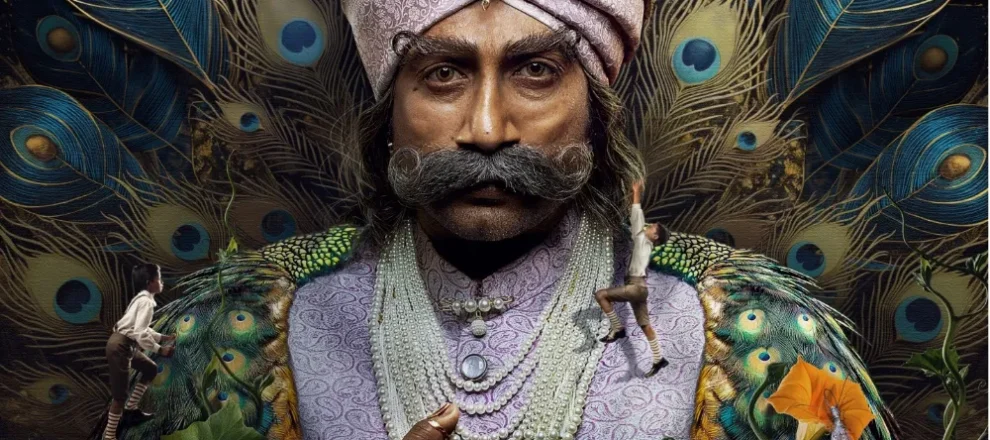
The arrival of Rao Bahadur feels like an important shift for Telugu cinema. It shows that bold ambition and artistic honesty can come together to create a film with true international appeal. Directed, written, and edited by Venkatesh Maha, the filmmaker behind acclaimed indie films like C/o Kancharapalem, this project marks a clear break from his usual grounded, slice-of-life style.
Instead, he steps into surreal territory, shaping a dense psychological drama that looks grand on screen and leaves a knot in the stomach. Backed by Mahesh Babu’s GMB Entertainment, the scale, detail, and emotional reach of Rao Bahadur place it among the standout Telugu films of the mid-2020s.
Themes: Dying Aristocracy and the Void Within
Rao Bahadur circles identity, decay, and inherited pain, built around the idea that “Doubt is a Demon”. The story unfolds in the shadow of a dying aristocratic world, focused on the title character, Rao Bahadur, who lives in his fading ancestral home, Bhuvanalayam. The film is not a simple period piece. It works as a layered psychological puzzle, where the outside world reflects the chaos inside his mind.
We see Rao Bahadur in two sharply different versions of himself. In one, he appears dishevelled, withdrawn, and clearly suffering from serious mental turmoil, claiming that a demon of doubt has taken hold of him. In the other, he wears the charm, polish, and posture of a proud nobleman, while building a relationship with a woman (Deepa Thomas).
These two realities constantly clash and overlap. The contrast forces viewers to question what is real for this man. Is the decaying mansion a picture of his collapsing mind? Is his refined, aristocratic image only a shield against a world that has moved on without him?
A parallel police investigation adds another dimension. It suggests that behind the inner conflict lies a very real and possibly dangerous secret. Maha uses visual motifs like peacock feathers, creeping vines, and recurring miniature figures to create a rich pattern of images. Power, decline, and inner struggle sit side by side in almost every frame, and the film asks the audience to stay alert and piece things together.
Venkatesh Maha’s Direction and Vision
| Aspect | Information |
|---|---|
| Title | Rao Bahadur |
| Director | Venkatesh Maha |
| Lead Cast | Satyadev Kancharana (as Rao Bahadur), Deepa Thomas (female lead), Anand Bharathi, Vikas Muppala |
| Producers | GMB Entertainment (Mahesh Babu and Namrata Shirodkar), SriChakraas Entertainments, A+S Movies, Mahayana Motion Pictures |
| Music | Smaran Sai |
| Release | Summer 2026 (theatrical, with international subtitled distribution) |
| Language | Telugu (Made in Telugu, for the world) |
| Genre | Psychological drama, suspense, dark comedy |
With Rao Bahadur, Venkatesh Maha confirms his place as one of the most distinctive voices in current Indian cinema. He moves beyond the clear, story-first approach of his earlier work and takes on a form that relies heavily on mood, tension, and suggestion. His combined roles as director, writer, and editor help him hold a tight grip over the tone and rhythm of the film.
The pacing feels intentional and steady. The film builds pressure through atmosphere rather than shocks or loud twists. The first half moves like a slow, heavy cloud over Bhuvanalayam, pulling us into the suffocating space of the house and the disturbed thoughts of its owner.
Maha does not rush to explain everything. He allows doubt, ambiguity, and unanswered questions to sit on screen. Some viewers expecting a straightforward thriller might find this demanding. Those who enjoy character-focused, slightly surreal cinema are likely to find the experience rewarding. His idea of a “Telugu story made for the world” comes through with clarity, in both the visual choices and the storytelling style, which feels ready for worldwide audiences without losing its regional roots.
Satya Dev’s Standout Performance
Rao Bahadur rests almost entirely on Satya Dev’s shoulders, and he rises to the chalstrikinglyashion. His physical change for the role is remarkable. Reports say he spent around five hours in the make-up chair each day to shape the look of the character.
Yet the true strength of his performance lies in the emotional shifts he brings to both sides of Rao Bahadur. As the broken, doubt-filled aristocrat, he carries a mix of fragility and quiet danger. He moves between a lost, almost childlike state and the grand, hollow exterior of a proud noble.
The character’s journey is full of conflict. Satya Dev shows a man caught between inherited prestige and personal collapse. Small changes in his face, posture, and voice do most of the work. His acting feels controlled but never stiff, and the viewer can sense the chaos behind his eyes.
The supporting cast adds important weight. Deepa Thomas gives warmth and texture to the relationship angle. Performers like Vikas Muppala and Bala Parasar provide believable reactions and energy around Satya Dev, which helps keep the high-strung psychological drama grounded in human feelings rather than just style.
Craft, Visuals, and Sound
On a technical level, Rao Bahadur stands out as a rich visual and sonic experience. Kartik Parmar’s cinematography shapes a distinct world that feels fully tied to the story. His use of light and shadow highlights the clash between the rotting splendour of the palace and the moments when the mind seems clear or romantic fantasy takes over. The gloomy, gothic corners of Bhuvanalayam sit in sharp contrast with bright, saturated, almost dream-like images.
Rohan Singh’s production design makes the aristocratic setting feel lived in and haunting. Every space carries a sense of former glory buried under dust and neglect. The detailed costumes, the heavy furniture, and the scattered objects inside the palace all speak of a family that once had everything and now holds on to leftovers.
Smaran Sai’s music lifts the entire film. His score does more than decorate the scenes. It works as a voice inside the story, with eerie tunes and layered sounds that track the rise of paranoia and fear. The mix of traditional-sounding elements with modern psychological scoring gives the film a distinctive sound that pairs neatly with the rich visuals.
Final Thoughts
Rao Bahadur is ambitious, visually lush, and deeply focused on the mind of a man falling apart. It asks for patience and close attention, and in return offers a bold, unsettling experience. Venkatesh Maha shapes a kind of cinematic maze, with Satya Dev at the centre delivering one of the most striking performances of his career.
The unhurried pace and refusal to spell everything out may not match mainstream tastes. For viewers who enjoy thought-heavy cinema, strong performances, and detailed craft work, Rao Bahadur stands out as a must-watch. It doubles as a sharp look at how doubt can eat away at a person from the inside, and as a showcase of how far Telugu cinema can go when it backs daring stories with top-tier talent and technical skill.