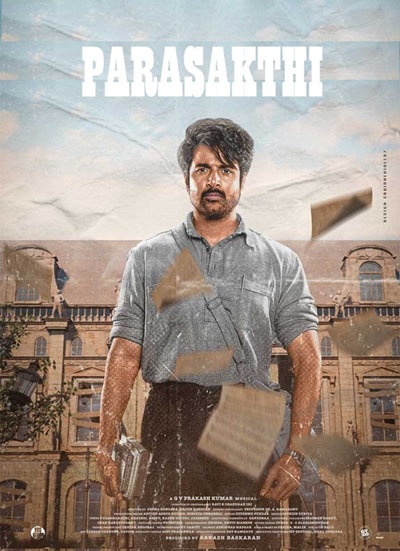
Parasakthi
Fun Facts of Movie
Parasakthi: The Explosive First Film That Changed Tamil Cinema
Parasakthi, directed by R. Krishnan and S. Panju, is one of the most talked-about films in Tamil cinema. It’s widely seen as a turning point. The film launched Sivaji Ganesan on screen and also brought S. S. Rajendran to cinema audiences.
Based on Pavalar Balasundaram’s play of the same name, the screenplay was written by a young M. Karunanidhi, who later rose as the political leader known as “Kalaignar.” His dialogue hit hard, mixing social criticism with rationalist ideas and strong attacks on caste bias and religious hypocrisy.
The film was produced by AVM Productions and is often linked to the cultural wave around the DMK movement because of its themes and tone. Music came from R. Sudarsanam and C. R. Subburaman, with stark black-and-white visuals that fit the story’s grit. The cast also includes S. V. Sahasranamam, Sriranjani Jr., and Pandari Bai.
Plot Summary: War, Loss, and a Family Torn Apart
The story plays out during World War II. Three brothers, Chandrasekaran (S. V. Sahasranamam), Gnanasekaran (S. S. Rajendran), and Gunasekaran (Sivaji Ganesan), live in Rangoon, Burma. They’re doing well there, along with Chandrasekaran’s wife, Saraswati.
They decide to return to Madurai for their sister Kalyani’s (Sriranjani Jr.) wedding. She’s set to marry a writer named Thangappan. Then disaster hits in quick succession. Thangappan dies in an accident. Their father, Manickampillai, dies from the shock. Kalyani is left widowed, pregnant, and with no support.
As the war worsens, the brothers get separated in the chaos. When they make it back to India, life doesn’t get easier. Gunasekaran, the youngest, faces betrayal, hunger, and constant cruelty from society. He changes from a trusting young man into someone hardened by what he sees. The story builds toward a courtroom finale where he speaks with rage and clarity, calling out hypocrisy and injustice. The family’s paths cross again as long-buried truths come out.
Themes: A Loud Challenge to Caste and Religious Exploitation
What keeps Parasakthi alive in public memory is its fearless message. Karunanidhi’s writing takes aim at religious fraud, caste oppression, and the way women are treated. The film doesn’t soften its anger. It puts harsh realities on screen and asks the audience to face them.
One of the most controversial moments involves Gunasekaran confronting a temple priest who tries to assault Kalyani. Scenes like this sparked outrage in 1952. Many accused the film of attacking faith and demanded it be banned. At the same time, these scenes matched the rationalist thinking tied to the Dravidian movement and pushed viewers to question custom and authority.
The film also shows what war and migration do to ordinary people. Poverty isn’t shown as bad luck or destiny. It’s shown as something created and protected by broken systems.
Sivaji Ganesan’s Debut: The Performance That Changed Everything
Sivaji Ganesan is the center of the film’s power. As Gunasekaran, he arrives with force. His style carries the weight of stage acting, but it still lands on camera. His courtroom speech became one of the most famous sequences in Tamil cinema, and it made him a star almost overnight.
He delivers lines about blind belief and social cruelty with a sharp edge. People remembered the words, but they also remembered the voice, the timing, and the intensity.
The supporting cast adds real strength. Sriranjani Jr. gives Kalyani a quiet pain that feels raw and personal. Pandari Bai brings steadiness and calm when the story turns harsh. Sahasranamam holds the family drama together with dignity and restraint.
Music, Visuals, and Style in a 1952 Classic
For a film made in 1952, Parasakthi moves with strong pace and heavy emotion. The black-and-white cinematography fits the tone of displacement and grief. The songs are present, but the dialogue leads the film, not the music.
Some moments may feel dramatic to modern viewers, with the kind of heightened acting common in that era. Still, that style fits what the film is trying to do. It pushes ideas through strong emotion, and it doesn’t hide its purpose.
Legacy: A Film That Changed Tamil Cinema
Parasakthi wasn’t just popular entertainment. It shifted what Tamil films could say and who they could speak for. It helped open the door for more socially driven storytelling and strengthened the DMK’s cultural voice through cinema.
More than 70 years later, people still bring up Parasakthi when talking about social justice, rationalism, and protest in Tamil Nadu. It launched careers, sparked arguments, and left a mark that hasn’t faded.
Trending Movies:
Chatha Pacha: The Ring of Rowdies Review (Spoiler-Light, January 2026)