

Some movies age like old photos; the edges curl, but the emotion stays sharp. Bommarillu is one of those rare Telugu films that people keep returning to, not just for the laughs or the songs, but for the uncomfortable honesty at its center.
Released in 2006 as a Telugu romantic comedy-drama, Bommarillu literally means “dollhouse.” That title is a clue, because the story is about a young man whose life is arranged, decorated, and controlled like a display piece. Anyone who’s ever been told, “It’s for your own good,” will recognize the tension right away. (For a quick factual overview of the film’s cast and credits, see the Bommarillu film background.)
Bommarillu in one line: story, setting, and what the movie is really about
At its simplest, Bommarillu follows Siddhu, a good son with a “good life” that doesn’t feel like his own. His father, Aravin,d plans everything, from major decisions to small choices, and Siddhu goes along with it until he meets Hasini and starts wanting something real, messy, and chosen.
It’s set in a comfortable, upper-middle-class world where expectations are polished, ed and smiles are practiced. Under that shine is the real question the movie keeps poking at: how much love becomes control before it starts to choke?
Quick plot snapshot (spoiler-light)
Siddhu (Siddharth) lives under the careful thumb of his father, Aravind (Prakash Raj), who believes a parent’s job is to steer the child’s life like a well-planned project. Siddhu’s engagement is arranged, and everyone around him seems to accept that this is just how things work.
Then Hasini (Genelia D’Souza) enters, bright and unfiltered, and Siddhu begins to feel like himself around her. The romance doesn’t just add sweetness; it forces a choice. The comedy lands because it’s rooted in awkward family truths, and the drama works because neither side is treated as purely right or wrong.

Themes that hit home: family control, freedom, and growing up
The father-son conflict feels real because it isn’t built on hate. Aravind genuinely believes he’s protecting Siddhu. Siddhu genuinely fears disappointing his father. That mix creates a pressure cooker where even “nice” moments can feel like traps.
The dollhouse idea fits Siddhu’s world perfectly. Everything looks ideal from the outside, but it’s also stiff, arranged, and airless. The film’s best insight is simple: independence isn’t rebellion, it’s adulthood. And adulthood often starts with one hard sentence said out loud.
Performances and characters: why Bommarillu feels so alive
A big reason Bommarillu still clicks is that the characters don’t speak like cardboard heroes. They talk like people who love each other and still manage to hurt each other.
The acting choices are small but effective: a pause before answering, a forced smile at the wrong time, a sudden snap after too much restraint. That’s where the film earns its emotional payoff, without needing constant melodrama.
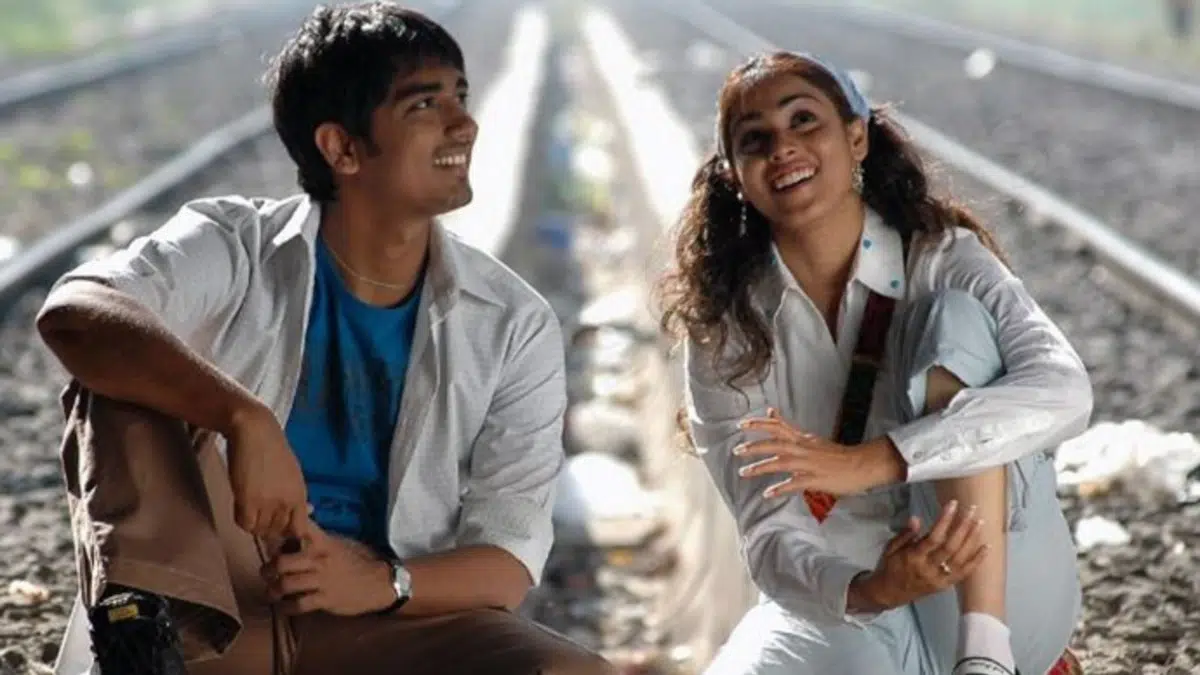
Siddharth as Siddhu: charming, confused, and easy to relate to
Siddharth plays Siddhu like someone who’s learned to be agreeable as a survival skill. Around his father, he’s careful and polite, the classic people-pleaser. Around friends, he loosens up, jokes more, breathes more.
That split is what makes the character work. Siddhu isn’t weak; he’s trained. When the film pushes him toward standing up for himself, the change feels earned because viewers have seen the cost of staying quiet.
For anyone who grew up with pressure dressed up as love, Siddhu’s arc hits a nerve. He doesn’t transform overnight; he stumbles into courage as most people do.
Genelia D’Souza as Hasini: bubbly energy that can feel sweet or too much
Hasini is the movie’s lightning bolt. She talks fast, acts on impulse, and brings a playful chaos that turns heavy scenes lighter. Genelia commits fully, which is why Hasini became such a pop-culture memory for Telugu audiences.
At the same time, Hasini can be divisive. Some viewers will find her behavior too loud and too childish, especially by today’s more grounded romantic-comedy standards. Others will say that’s exactly the point. Hasini isn’t written as “realistic” in every beat; she’s written as a force that disrupts Siddhu’s controlled life.
Either way, the performance is fearless, and the film depends on that energy to keep the tone from sinking.

Prakash Raj as Aravind: the strict dad who is not a cartoon villain
Prakash Raj gives Aravind weight without turning him into a mustache-twirling tyrant. He’s firm, proud, and certain he knows best, but he’s also capable of warmth. That combination is what makes him believable, because real control rarely shows up as constant cruelty. It often shows up as constant certainty.
The movie also lets Aravind have his own logic. His viewpoint isn’t excused, but it’s understood. That’s why the father-son scenes can feel so tense; they’re not just arguments, they’re two versions of love colliding.
Direction, music, and pacing: what makes Bommarillu rewatchable
Even with its big emotions, Bommarillu stays easy to follow. Director Bhaskar builds the story with everyday moments that quietly stack up until they can’t be ignored.
The film’s humor also helps. It doesn’t erase the conflict; it just gives the audience room to breathe. That balance is a major reason it remains a comfort watch for many.

Bhaskar’s storytelling: simple scenes, strong payoffs
Bhaskar’s direction works because it trusts small scenes. A family gathering can feel like a courtroom. A casual “suggestion” can land like an order. The writing shows how control hides inside normal routines.
Most of the time, the film avoids feeling preachy because it doesn’t stop for speeches. It shows patterns, then lets the audience connect the dots. When emotions boil over, it feels like the result of many tiny cuts, not one sudden plot push.
Devi Sri Prasad’s soundtrack and background score
Devi Sri Prasad’s music is a big part of the movie’s staying power. The songs carry the youthful mood, and the background score helps scenes shift from comedy to emotion without a harsh jump.
Even people who haven’t watched the film in years tend to remember the sound of it. One reason is that the music doesn’t fight the story; it rides alongside it, keeping the romance warm and the family tension sharp.

Runtime and pacing: where it flies, and where it drags
The runtime is about 2 hours and 48 minutes (168 minutes), and that length shows. The film moves quickly when it’s in romance-and-comedy mode, especially in the lighter stretches.
Some of the longer family portions can feel repetitive, with similar conflict beats arriving again before the story fully turns. Still, the emotional build often makes that patience pay off, especially for viewers who like family dramas that sit in the discomfort instead of rushing past it.
Verdict: Is Bommarillu worth watching in 2026, and who will love it
As Bommarillu nears its 20-year mark in August 2026, it still holds up as a crowd-pleasing film with a serious backbone. In the US, streaming availability can shift, but recent listings have placed it on Tentkotta via subscription. It’s also smart to confirm current options through a tracker like the Bommarillu streaming listing.
In plain terms, its strengths are clear: relatable family tension, charming lead chemistry, a father character written with depth, and music that sticks. Its weak points also show: a long runtime, a few repeated emotional beats, and a heroine whose exaggerated quirks won’t work for everyone.
It’s best for viewers who enjoy family dramas with humor, romance-comedies that actually say something, and coming-of-age stories where “growing up” means drawing boundaries.
What holds up today, and what feels dated
What still feels fresh is the emotional core. The father-son dynamic doesn’t rely on a villain; it relies on a relationship that’s too close and too controlling at the same time. The acting still carries scenes without needing flashy tricks.
What may feel dated is the style of some comedy beats and the way certain “cute” behaviors are played extra bbroadly Modern viewers who prefer quieter rom-com energy might need a few minutes to adjust.
Conclusion
Bommarillu became a beloved Telugu blockbuster because it wraps a painful truth in a crowd-friendly package. It’s funny, romantic, and musical, but it’s also about a young man stepping out of a family “dollhouse” and choosing his own life. Nearly two decades later, that message about personal freedom inside loving families still hits.