

What happens when a love story runs on pure stubborn energy? Arya (2004) answers that question with a college romance that keeps swinging between sweet, funny, and intense.
This review is about the 2004 Telugu film Arya starring Allu Arjun (not the Tamil actor Arya). It’s a mash-up of romance, action, and family pressure, told with a lot of attitude and big emotions.
Below is a clear look at the story setup, performances, music, pacing, and who it still works for today, without giving away the ending.
Quick facts about Arya (2004) before the review
Arya was released on May 14, 2004, and it quickly became known as a crowd-pleaser that mixes romance with punchy conflict. It’s often labeled as a romantic action comedy, and it wears all three parts proudly.
Here’s a tight snapshot for anyone who wants the basics first:
| Detail | What to know |
|---|---|
| Release date | May 14, 2004 |
| Language | Telugu |
| Genres | Romance, action, comedy (with drama beats) |
| Runtime | About 2 hours and 31 minutes |
| Director | Sukumar |
| Music | Devi Sri Prasad |
| Cinematography | R. Rathnavelu |
| Lead cast | Allu Arjun, Anuradha Mehta, Siva Balaji |
| Typical fan ratings | Around the high-7s out of 10 |
For a quick reference on official credits and release details, see the [Arya (2004) film summary](https://en.wikipedia.org/wiki/Arya_(2004_film).
It also helped push Allu Arjun to a new level of popularity at the time. Even now, it’s the kind of title fans bring up when talking about his early “star-making” phase.

The basic setup, without spoilers
Arya is a free-spirited college guy who falls hard, fast, and openly for Geetha (sometimes referred to as Geethanjali). The problem is simple and huge; she doesn’t feel the same way, and she’s already tied to Ajay, a guy with a rough reputation.
Instead of backing off quietly, Arya stays in Geetha’s orbit. He tries to win her over through presence, effort, and a kind of loyalty that doesn’t come with an off switch.
That persistence sparks jealousy, rivalry, and pressure from people who want Geetha’s life to follow a strict script. The movie keeps raising the heat, sometimes through comedy, sometimes through fights, and sometimes through emotional scenes that land like a brick.
Main cast and the roles viewers should notice
Allu Arjun plays Arya with a mix of charm, stubborn confidence, and playful swagger. The role asks him to be funny one minute and intense the next, and he’s clearly enjoying the ride.
Anuradha Mehta plays Geetha as someone trying to hold her ground in a messy situation. She’s not written as a simple prize; she’s a person dealing with pressure from multiple sides.
Siva Balaji plays Ajay, a key force in the story’s tension. The movie needs someone who can bring threat and insecurity without turning into a cartoon, and he mostly does.
The supporting characters bring humor, chaos, and momentum. They also keep the college setting feeling busy, like emotions are always on display, and everyone has an opinion.

Story and pacing: what works, and what drags
Arya is built around a clear idea: a guy loves a girl, and he won’t stop showing it. That clarity helps. Even when the plot takes turns, the movie keeps returning to the same question: Will Geetha accept Arya, reject him, or choose something else entirely?
The first stretch tends to fly by because the tone feels light. There’s flirting, social friction, and public moments where Arya makes his feelings impossible to ignore. The movie wants the audience to laugh at his boldness and also admire his confidence.
As it goes on, the conflicts stack up. Rivalry becomes more serious, and family pressure starts shaping decisions. That’s where the runtime can feel heavy. At about 2 hours and 31 minutes, it sometimes repeats the same emotional point in different scenes.
Still, the movie earns some of its length by letting tension simmer. It also uses shifts in mood to keep viewers awake, a joke, then a scuffle, then a serious talk, then a romantic beat. When those switches are smooth, it’s fun. When they’re not, it can feel like channel surfing.
Romance angle: charming, intense, or too much?
The romance is the movie’s engine, and it’s also the part modern viewers will debate the most.
On the sweet side, Arya’s devotion reads like a loud promise. He wants to be present in Geetha’s life, help her, protect her, and prove he’s serious. The film frames love as something active, not shy.
On the tougher side, the movie treats persistence as a romantic tool, and that can land differently today. Some scenes may feel pushy, since Geetha’s boundaries don’t always stop Arya from trying again. Viewers who prefer softer love stories might find that tiring.
The best way to watch it now is to see it as a time capsule. Early 2000s mainstream cinema often rewarded the hero for refusing to quit. Arya is a strong example of that style, for better and for worse.
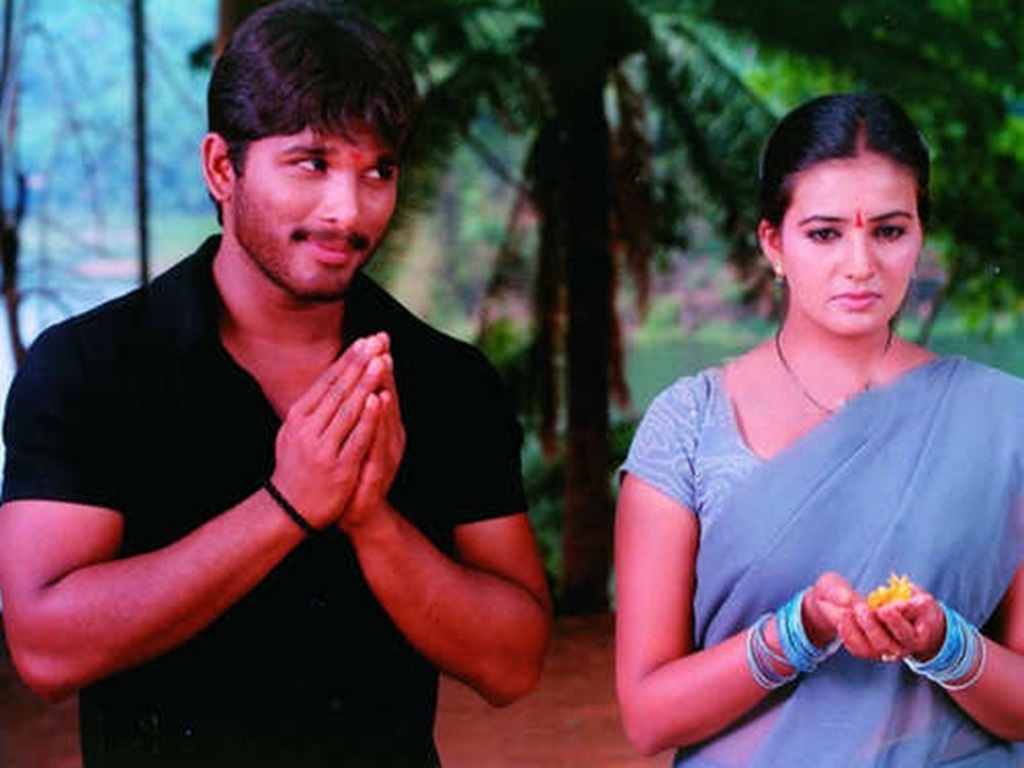
Action and drama beats: do they raise the stakes or feel random?
The action is not just decoration. Most fights come from rivalry, ego, or the need to protect someone. That connects the violence to the story, instead of making it feel like a separate movie.
That said, the tone can swing hard. A playful scene can be followed by a serious confrontation, and sometimes the jump is abrupt. When the movie lands a transition, it feels like a pressure cooker, with comedy on top and danger underneath. When it misses, it feels like the film is trying to do too many things at once.
The drama beats work best when they’re personal. The story gets stronger when it focuses on how public pressure and pride mess with people’s choices. It gets weaker when conflict is stretched longer than it needs to be.
Performances, music, and overall mood
Even people who don’t love the story’s attitude often remember Arya for its vibe. The film has a restless energy, and it’s carried by a lead performance that refuses to play small.
The overall mood is colorful and loud, with romance painted in bright strokes and conflict framed as something that can explode at any time. That style won’t be for everyone, but it’s consistent.
The movie also benefits from music that knows what it’s doing. In films like this, songs and background score aren’t just breaks; they’re emotional instructions. Arya uses them to tell viewers when to smile, when to feel tension, and when to brace for impact.

Arya’s breakout energy and the lead chemistry
Allu Arjun’s Arya is written as someone impossible to ignore, and the performance matches that. His body language is open and bold. His reactions are big. Even when he’s standing still, he looks like he’s about to make a choice that changes the room.
That “breakout” feel comes from commitment. He doesn’t play Arya as a regular guy with a crush. He plays him like a force of nature, which is why the character can feel lovable in one scene and overwhelming in the next.
The chemistry between the leads is interestingly mixed. It’s not built on mutual comfort early on. It’s built on friction. That makes their scenes feel active, like something is always being tested. Viewers who want equal romance energy from both sides may feel frustrated, but the push and pull is the point.
Songs, background score, and cinematography that shape the vibe
Devi Sri Prasad’s music helps the film stay memorable long after the plot details fade. The songs act like mood markers, turning simple moments into set pieces and giving the romance extra shine.
The background score also does a lot of work during confrontations. It tells the audience when a scene is turning serious, even before a character throws a punch or raises their voice.
Visually, the cinematography by R. Rathnavelu keeps things clean and stylish without getting confusing. The lighting and color choices support the movie’s emotional swings. Brighter scenes feel playful and young, while darker moments feel heavier and more serious. Camera movement often adds speed to confrontations, which helps action scenes feel urgent.
Is Arya worth watching now, and who will enjoy it most?
For a viewer in the US discovering Indian cinema, Arya (2004) can be a surprisingly easy entry point if they’re open to older romance tropes and long runtimes. It’s clear, emotional, and designed to entertain in big beats.
It’s best for people who like:
- early 2000s romance with bold heroes
- college settings with rivalry and comedy
- Stories where love and ego collide in public
It may not work as well for viewers who want a subtle romance or a shorter, tighter script. The movie’s strongest scenes have punch and personality. Its weakest moments come when it circles the same idea too long.
For a quick snapshot of how audiences rate it today, the IMDb rating and user reviews for Arya (2004) give a useful sense of its long-term appeal.
Content-wise, expect fight scenes, threatening behavior from rivals, and high emotional tension. It’s not graphic in a modern streaming sense, but it is intense.
Best reasons to watch, and best reasons to skip
- Watch it for Allu Arjun’s early star power, which carries the movie even when the script repeats itself.
- Watch it for the mix of tones, because it jumps from funny to tense in a way many fans still enjoy.
- Watch it if you like loud, emotional romances, where the hero’s feelings are never hidden.
- Skip it if persistence-as-romance bothers you, since some scenes can feel dated in how they treat boundaries.
- Skip it if long runtimes wear you out, because the pacing gets uneven in the back half.
If they liked Arya, what should they watch next?
First, it helps to clear up a common mix-up: “Arya 2” (2009) is a different Telugu film connected by theme and creator, not a remake of the Tamil actor’s work and not related to the title as a franchise in the Hollywood sense. It gained fresh attention with a theatrical comeback, covered in this report on Arya 2 returning to theaters in 2025.
If the main draw was the lead’s energy, exploring more films starring Allu Arjun makes sense, especially titles where he balances comedy, romance, and swagger.
If the search is actually for the Tamil actor Arya, that’s a different path entirely. Recent coverage in 2025 confirmed the title and early promotion for Ananthan Kaadu, including a released title teaser, with reporting describing it as a major multi-starrer project. Separate listings have also referenced Kadhal 2 Kalyanam with a date tied to July 13, 2026, and early 2026 chatter has kept curiosity alive. For fans, the smart move is to check official announcements as dates can shift.
Conclusion
Arya (2004) still plays like a loud love letter written in bold marker, messy, confident, and hard to ignore. Its biggest strength is the breakout lead performance, backed by catchy music and an entertaining mix of moods. Its biggest drawback is length, plus a few romance choices that can feel dated today. For viewers who enjoy early 2000s romance-action films, it’s a solid pick for a weekend watch at home.