
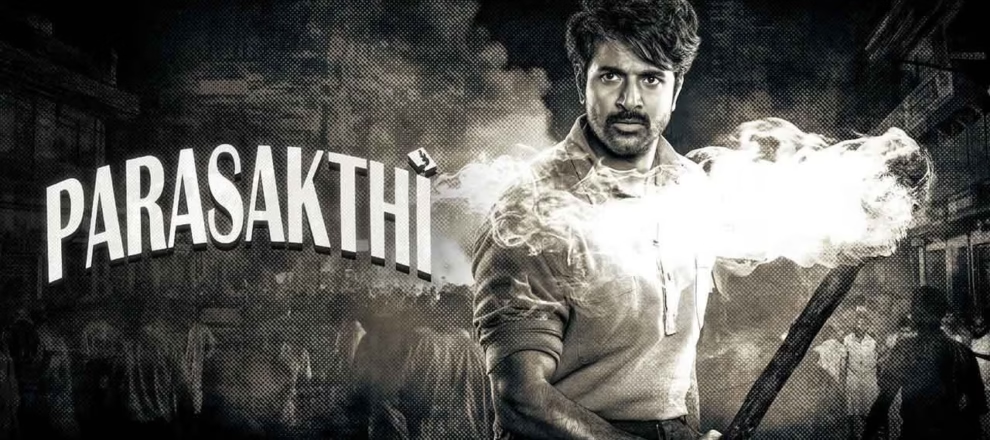
In Tamil cinema history, very few titles carry as much political and cultural weight as Parasakthi. The 1952 original, starring the iconic Sivaji Ganesan and written by M. Karunanidhi, was not just another release; it was an open rebellion on film.
It tore into caste hierarchy, religious double standards, and social inequality, and sparked arguments that changed both Tamil politics and filmmaking. The film was banned in parts of India for its sharp attack on Brahminical privilege, which only strengthened its legend.
Jump to 2026, and Sudha Kongara brings Parasakthi back to the big screen with full force. Her version shapes the title into a charged political period drama rooted in the 1965 Anti-Hindi Imposition protests. Led by Sivakarthikeyan, with Ravi Mohan as the primary antagonist, the cast also includes Atharvaa, Sreeleela in her Tamil debut, Basil Joseph, Rana Daggubati, and strong supporting work from Guru Somasundaram, Prithvi Pandiarajan, and Dev Ramnath. This is not a polite tribute.
It feels like a loud, angry reclaiming of Tamil linguistic pride at a time when cultural uniformity is pushed from all sides. The film landed on 14 January 2026, right in the middle of the Pongal season, going head-to-head with Vijay’s farewell film Jana Nayagan and turning the festival into a major box-office showdown.
Crushes local languages
Directed by Sudha Kongara (known for Irudhi Suttru and Soorarai Pottru, both packed with emotion and clear political intent), this version of Parasakthi steps straight into the chaos of the 1960s. Inspired by real incidents, it follows student leaders and ordinary Tamil youngsters who refuse to accept Hindi as the only national language. For them, the policy feels like yet another form of control that crushes local languages.
The story unfolds across protest-filled streets of Madras (now Chennai), where self-immolations, lathi charges, and heated debates turn the city into a war zone of ideas. Kongara co-writes the screenplay with Arjun Nadesan, while Madhan Karky and Shan Karuppusamy handle the dialogues. Together, they shape a film that works less like a dry historical account and more like a long, grieving poem that mourns silenced voices, yet also urges people to keep their fight alive today.
For Sivakarthikeyan, this 25th film marks a major shift. In his first outing with Kongara, he drops his familiar comic charm and takes on a layered role. He plays a fictional mix of several real figures, a college student who grows into a hardened activist. His arc, from hopeful youngster to unshakeable rebel, reflects the political awakening of an entire generation. His performance hits with surprising force.
His gaze carries anger and hurt, his thin frame looks fragile in violent rallies, yet moves with fierce intent. This is not the breezy lead from Doctor or Maaveeran. Here, SK turns into a quiet firebrand who recites Tamil poetry in one scene and hurls petrol bombs in another. The part demands both strength and tenderness, and he brings both. The character constantly brings to mind real-life martyrs of the language struggle, such as Chinnasamy, who chose to die by fire as a final act of protest.
Sivakarthikeyan crackles with energy
The supporting cast pushes the film to near-operatic drama. Ravi Mohan, in his first outright negative role, is a shrewd bureaucrat who forces Hindi into the syllabus. A Brahmin official with soft-spoken menace, he hides cruelty behind polished words. His face-offs with Sivakarthikeyan crackle with energy, filled with barbed lines that echo the sharp political speeches of the 1952 Parasakthi.
Atharvaa brings strong emotional weight as another activist, a young man torn between public duty and private grief. His bond with Sreeleela, who plays a daring journalist, gives the story a fragile but moving love angle. It never distracts from the struggle; instead, it humanises it.
Sreeleela, coming off Telugu hits like Guntur Kaaram, slips into Tamil cinema with confidence. Her character throws herself into risky coverage of the protests, and her fierce presence in the street scenes often pulls focus away from everyone else. Basil Joseph appears as a Malayali thinker who also offers moments of sharp humour, keeping parts of the film from becoming too heavy.
Rana Daggubati, as a trade union leader, uses his physical presence to full effect. He feels like the muscle of the movement, the one who turns words into action. Guru Somasundaram and Prithvi Pandiarajan round out the cast as workers, writers, and everyday fighters, filling the margins with life so that even minor characters feel like people, not stock figures.
On the technical side, Parasakthi excels at building a believable 1960s world. G. V. Prakash Kumar’s music drives the emotions of the film. He mixes pounding nadaswaram with electric guitars, creating protest tracks that feel both old and new. Songs like the title track, “Parasakthi Paravattum” (“Let the Fire Spread”), stay in your head long after the credits. The lyrics read like a modern Dravidian political anthem, yet still work as catchy film songs.
Ravi K. Chandran’s cinematography gives the film a strong visual identity. He uses warm, sunlit frames for Tamil Nadu’s streets and villages, from Marina Beach packed with protestors to temple-filled lanes in Madurai. In contrast, scenes shot on Sri Lankan sets, drenched in rain and shadow, give a sense of threat and distance, like the outside world watching on. Sathish Suriya’s editing keeps the 165-minute length from dragging. He cuts between recreated scenes and real archival footage from the 1965 riot, so the film almost feels like a documentary at times, but still stays firmly cinematic.
The reuse of reuse of Parasakthi
The production, handled by Aakash Baskaran’s Dawn Pictures, had its share of turbulence. The project started with a different line-up that included Suriya, Dulquer Salmaan, Nazriya Nazim, and Vijay Varma. A major reshuffle in 2025 changed the cast to the current one, which, in hindsight, fits perfectly with the film’s raw tone. Shooting took place across Chennai, Karaikudi, Pollachi, and Sri Lanka, and wrapped in October 2025, leaving just enough room for a tight post-production schedule before the Pongal release.
The film is not without weak spots. At times, the writing leans into open preaching. Some scenes talk about Tamil pride in such absolute terms that they risk sounding exclusionary and may push away viewers who stand outside the politics. This mirrors the old debates around the 1952 film, which was also accused of going too hard at its targetsOff-screenen, arguments around the title had already sparked fresh controversy.
Fans of Sivaji Ganesan protested against the reuse of Parasakthi, and there were reported issues with Vijay Antony’s Telugu dubbed version. Even though Dawn Pictures acquired the rights from AVM, traces of these disputes show up in the film, which occasionally feels like it is defending itself.
Kongara’s women characters are strong, vocal, and central to the story, yet now and then they fall into familiar sacrifice-driven storylines. These choices feel slightly dated in an otherwise sharp and modern piece of political cinema.
In spite of these flaws, the film’s power is hard to ignore. Released in a time when debates around the National Education Policy and the three-language formula are heating up, and when Hindi is slowly becoming more dominant on OTT platforms and in pop culture, Parasakthi 2026 feels urgent. It does not sit back and admire the past. It treats history as a warning.
The film argues that language is not just a tool for communication; it is also memory, dignity, and power. Once people rise to defend it, the fire is hard to put out. With Sivakarthikeyan delivering what may stand as the defining performance of his career, Sudha Kongara pushing her political storytelling to a new level, and a fully committed ensemble cast, Parasakthi arrives as a bold Pongal release that feels raw, necessary, and deeply Tamil.
Rating: 4.5/5. Watch it not only for drama and songs, but also for a clear, stirring reminder of why this history still matters.
Parasakthi Plot Overview
The story draws from the real events of the 1965 Anti-Hindi Imposition Movement in Tamil Nadu. It follows students, young activists, and regional leaders as they push back against the central government’s decision to promote Hindi as the single official language. The film looks at social justice, linguistic identity, and political unrest through the eyes of those who lived through that period.
Set in the mid-1960s, it traces both street-level protests and the personal cost of resistance. Families split over ideology, friendships fracture under pressure, and ordinary lives are pulled into a fight that feels bigger than any one person. The promotional material hints at a high-tension story with arrests, betrayals, and sacrifices, as well as a strong emotional core that binds the characters together.
Cast and Crew
Director: Sudha Kongara Prasad
Lead Cast:
- Sivakarthikeyan is the main protagonist, a student who becomes a key activist
- Sreeleela, in her Tamil debut, in a pivotal female lead role
- Atharvaa
- Ravi Mohan
Supporting Cast:
Prithvi Pandiarajan, Basil Joseph, Guru Somasundaram, Chetan, Abbas, Rana Daggubati (reported or confirmed in ensemble roles)
Music: G. V. Prakash Kumar, with lyrics by Yugabharathi, Ekadesi, Arivu, and other lyricists
Production Notes:
The film began with an earlier cast that included Suriya, Dulquer Salmaan, Nazriya Nazim, and Vijay Varma, but the team chose to rework the line-up for creative reasons. The shoot concluded in October 2025, and post-production has been in progress ahead of the January 2026 release.