
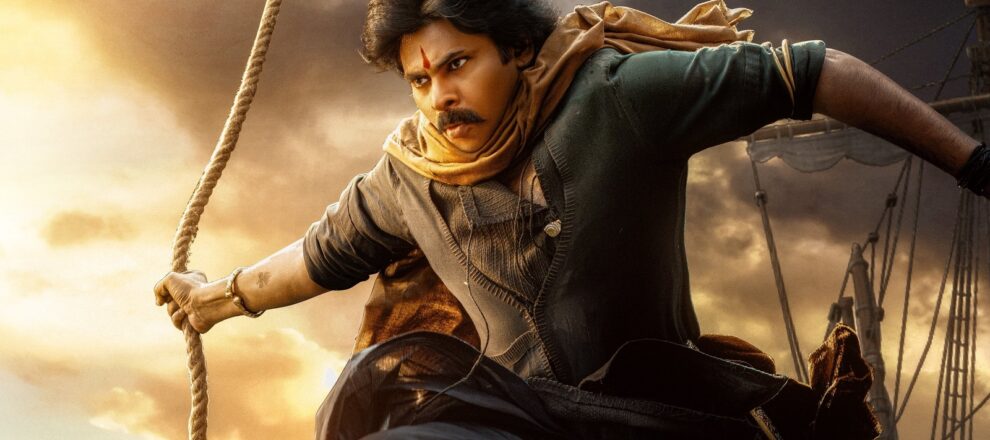
In recent Telugu cinema, few titles created as much buzz, or faced as many setbacks, as Hari Hara Veera Mallu: Part 1 – Sword vs Spirit. Directed by Jyothi Krishna and Krish Jagarlamudi, this historical action drama finally hit theaters on July 24, 2025, after a rocky production of more than five years. The shoot stalled due to the COVID-19 pandemic, behind-the-scenes creative clashes, and Pawan Kalyan’s move into politics as Deputy Chief Minister of Andhra Pradesh.
The movie arrived with a massive budget of about ₹300 crore and the promise of a franchise. Marketed as a two-part saga, it focuses on the 17th-century outlaw Veera Mallu, a Robin Hood-style rebel who rises against Mughal Emperor Aurangzeb. Drawing loosely from folklore, the film promises heist thrills, patriotic fire, and a hero who fights to protect dharma and the oppressed.
On paper, it sounds like a sure-shot epic. In practice, Hari Hara Veera Mallu lands with a soft thud. The ambition is clear, but the film feels scattered and uneven. With a 6.0/10 rating on IMDb, mixed to poor reviews, and a domestic gross of about ₹86 crore, it turned into a box office letdown. This review breaks down what works, what falls apart, and why the film has become such a divisive experience.
Hari Hara Veera Mallu Plot Summary
Set in the 1650s under Mughal rule, Hari Hara Veera Mallu follows Veera Mallu (Pawan Kalyan), a sharp and daring thief shaped by resistance in the diamond mines of Kollur. Orphaned by imperial brutality, Veera grows into a folk legend, robbing the rich and powerful to help the poor and helpless.
The main plot kicks in when the ruler of Kollur hands Veera an almost impossible task: steal the fabled Koh-i-Noor diamond from Aurangzeb’s (Bobby Deol) peacock throne in Delhi. Veera puts together a small gang, including the fiery Panchami (Nidhhi Agerwal) and seasoned fighters played by Sathyaraj and Nassar, then begins a dangerous journey from Golconda to the Mughal capital.
The first half does a better job of holding attention. We see Veera in action during a fierce clash with Portuguese traders at a port, a wrestling contest near Charminar, and a tense escape with Panchami that mixes action with light romance. These sequences keep the energy alive while teasing something deeper beneath the hero’s swagger.
Through flashbacks, the film explains Veera’s hatred for Mughal rule. Scenes of unfair taxes like the Jizya on Hindus and attacks on temples give context to his fight, which the film frames as a “battle for dharma.” The interval sequence raises the stakes as Veera gets closer to Aurangzeb’s inner circle, leading to a cliffhanger that promises a bigger rebellion in Part 2.
The second half, however, loses grip. Too many side plots creep in, including half-baked romance, forced emotional scenes, animal fights, and scattered cultural inserts. The heist angle, which should drive the story, keeps getting pushed aside. Veera’s character journey turns shaky, with long speeches and rushed alliances that lack depth or payoff.
By the time the film heads toward its pre-climax, it focuses more on setting up Part 2 than giving Part 1 any real closure. At about 170 minutes, the movie feels stretched. The pacing slows down like a loaded caravan, and several plot threads hang loose. Sai Madhav Burra’s writing has flashes of poetic lines, but the split directorial inputs clash in tone. Krish’s taste for grandeur and emotional scale collides with Jyothi Krishna’s mass-heavy style, leaving the script stuck between meaning and mere spectacle.
Cast Performances: Pawan Kalyan Holds It Together
Pawan Kalyan is the main reason the film remains watchable. He plays Veera Mallu as a calm yet intense rebel, larger than life but still grounded when the writing allows it. His physical look helps a lot: lean frame, battle marks, long hair, and sharp eyes that suit a 17th-century warrior-thief.
His dialogue delivery carries weight, especially with lines like “Dharma is not a crown to wear, it is a sword to wield.” These standout moments land strongly in crowd-pleasing scenes and elevation shots. His sword fights, measured walk, and controlled rage remind viewers why he still draws fans in huge numbers. At the same time, some of his long speeches drag, partly due to the direction. What should feel like a powerful ideology turns into an overdone monologue.
Nidhhi Agerwal’s Panchami has sparks of promise but lacks depth on paper. She plays the character with energy, showing both strength in combat and softness in emotional scenes. A key escape sequence highlights what she can do when the writing supports her. Still, her chemistry with Pawan feels more functional than organic, since the songs and romantic bits appear forced and oddly placed.
Bobby Deol as Aurangzeb brings a strong presence. His heavy stare and firm voice give the ruler a sense of danger, but the role is written in broad strokes, and the limited screen time keeps him from becoming a layered antagonist. He is dangerous, but not very interesting.
The supporting cast includes Sathyaraj as a rough mentor figure, Nassar as a scheming court insider, and comedians like Sunil and Raghu Babu for lighter moments. They do their jobs but rarely leave a lasting mark. Kota Srinivasa Rao’s brief turn as a wise elder gives the film one of its emotional touches, especially because it is one of his final appearances, but his impact is short-lived. Overall, the actors try to rise above the script, and Pawan Kalyan is the only one who truly manages to shine through the fog.
Direction and Screenplay: Big Vision, Wobbly Storytelling
Jyothi Krishna and Krish Jagarlamudi pull the film in two different directions, and the split personality shows on screen. You can see Krish’s hand in the scale of the world. Wide shots of the Kollur mines, Mughal forts, and battlefields hint at a big theatrical experience. Those moments recall the sweep of films like Baahubali, at least visually.
The problem lies in tone and focus. What starts as a smart heist story slowly turns into a sermon-heavy drama about a besieged “Sanatana Dharma.” Historical elements like Aurangzeb’s temple destruction and religious taxes are part of the record, but the way the film presents them often feels one-sided and heavy-handed. Scenes of temple attacks, humiliation of common folk, and religious slogans lack nuance and may push away viewers who want balance rather than constant blame.
The screenplay packs in too much. Veera’s hidden past, the backstories of side characters, and hints about larger conspiracies are introduced but rarely resolved satisfactorily. The result is a crowded script that struggles to connect its parts.
Pacing hurts the film the most. The first half moves at a decent clip and keeps you curious. The second half slows down and repeats ideas, with action scenes that blur into one another and emotional arcs that lose spark. Ending Part 1 in the middle of the bigger mission is a bold choice, but the film does not offer enough closure to justify it. Instead of a gripping midpoint, it feels like an incomplete cut.
Sai Madhav Burra’s dialogues stand out in isolated scenes. Lines like “The Koh-i-Noor is not a gem, it is the tear of a conquered Bharat” hit hard and will likely be quoted by fans. But when every other scene tries to be a punchline or slogan, the impact wears off. The writing starts to feel loud instead of strong.
Technical Aspects: Strong Music, Weak VFX, Uneven Craft
On the technical side, Hari Hara Veera Mallu swings between impressive and embarrassing.
M.M. Keeravani’s background score is the clear highlight. His mix of folk beats, grand orchestral pieces, and choral themes adds emotional weight to many scenes. The interval score and songs like “Taara Taara” boost the drama and create an atmosphere of rebellion and longing. Even when the writing falters, the music often keeps the scene alive. The songs, however, do not always blend well into the story. Some of them feel like showy inserts, packed with CGI-heavy visuals that hint at the film’s bigger problem.
The cinematography by Gnana Shekar V.S. and Manoj Paramahamsa is solid during on-ground sequences. The golden light in the mine scenes, the torch-lit chases around Charminar, and the framing of the forts give the film a rich texture. Thota Tharrani’s production design adds another layer, with grand Mughal courts, detailed peacock thrones, and massive sets that feel lived in.
All that effort is let down by poor visual effects. The CGI animals, especially the tiger in a staged fight scene, look like they belong in an early video game. The color grading shifts without clear intent, jumping between dusty realism and bright fantasy. In some scenes, basic compositing errors stand out, like shadows that do not match or props that look like they are floating. Reports of audiences laughing at these moments say a lot. For a film sold as a big-budget spectacle, such flaws break immersion and trust.
Praveen K.L.’s editing does not help either. The movie carries several unnecessary montages, songs, and slow-motion shots that add length but not meaning. A sharper trim could have reduced bloat and fixed some of the pacing pain. The action, arranged by Nick Powell, Peter Hein, and others, has peaks and drops. A few fights, like the port battle and the interval clash, feel thrilling and well-staged. Later fights rely more on CGI and wirework, losing their impact.
Sound design boosts Keeravani’s music and gives weight to swords, explosions, and crowd scenes. Yet dubbing issues, especially in the other language versions, break the illusion in places. Overall, the technical team shows intent but falls short on polish, which is deadly for a film that leans so much on scale.
Thematic Depth: Rebellion, Faith, Or Plain Propaganda?
At its heart, Hari Hara Veera Mallu wants to tell a story about resistance to tyranny. Veera stands as a symbol of people who fought against injustice and foreign rule. The movie stresses how history has been softened or forgotten and tries to bring back anger against Mughal excesses like forced conversions and economic exploitation.
Many scenes are tailored for an audience that favors cultural nationalism. The Jizya protest, with crowds shouting “Har Har Mahadev,” is loaded with emotion and is designed to stir pride. For viewers who share that ideology, these moments feel strong and affirming.
The flip side is that the film offers almost no complexity in its portrayal of Aurangzeb and the Mughals. The emperor is shown as a cold villain with no internal conflict or political layers. Hindu groups are shown as united and pure, with little reference to their own divisions or flaws. This makes the movie feel more like a one-sided rally than a serious historical epic.
Critics have called it a weak period film that leans toward hate instead of thoughtful reflection. Supporters argue that the film “tells the truth” and gives voice to buried stories. That split in reaction is why the movie feels so polarizing. The tagline “Sword vs Spirit” hints at the clash between physical power and spiritual resolve. In practice, the film pushes the spiritual and ideological messaging so hard that the sword and the story lose sharpness.
Conclusion: A Grand Idea That Loses Its Way
Hari Hara Veera Mallu: Part 1 is the kind of film that should have been a milestone for Telugu cinema. It has a massive star, a rich historical backdrop, and a seasoned music director. On top of that, it had time and money on its side.
What we get instead is a mixed bag. Pawan Kalyan’s screen presence and Keeravani’s music carry several scenes, but the rough VFX, uneven tone, bloated screenplay, and clumsy messaging drag the film down. For die-hard fans of Pawan or for viewers who enjoy loud historical drama with strong ideological notes, it might still work as a one-time watch. For most others, it is likely to feel underwhelming.
With Part 2 on the way, there is still a chance to fix things. A tighter script, better visual effects, and a more balanced take on history could still turn Veera Mallu’s story into something memorable. For now, though, Hari Hara Veera Mallu: Part 1 – Sword vs Spirit stands as a warning that scale and intent are not enough without control and cohesion.
iBomma Rating: 2.5/5, ambitious in scale but lost in execution.